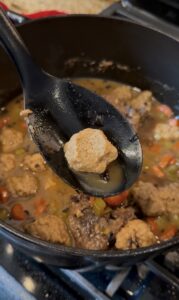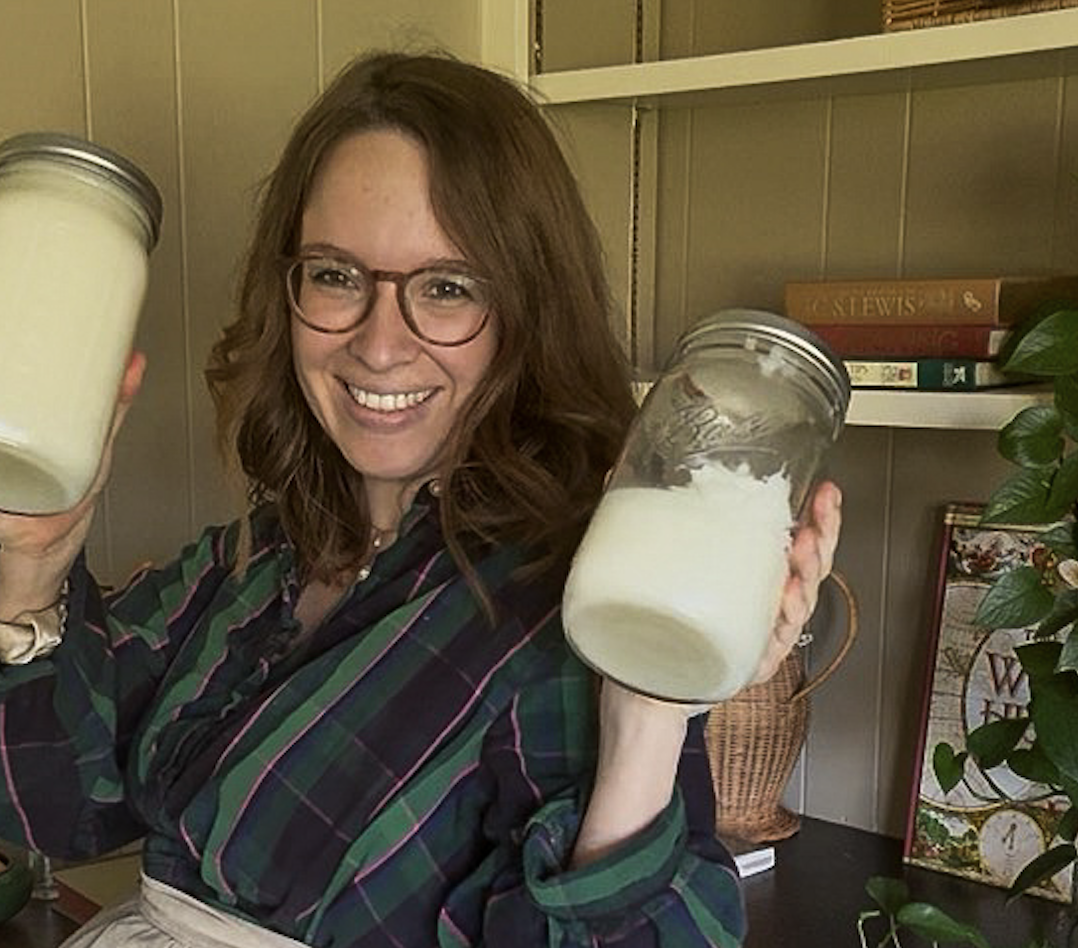
Einkorn has high protein/gluten but behaves like a low-gluten soft wheat when baking.
Einkorn: What Exactly Is It?
If you or your family are on any kind of health journey, you have probably heard about einkorn! It seems like everyone nowadays is talking about einkorn, which is awesome. SO, what exactly is einkorn? I’ll tell you!
Einkorn is an ancient wheat, which means it belongs to one of the oldest species of wheat cultivated by humans. In fact, einkorn is considered one of the earliest domesticated wheat species, with evidence of its cultivation going back roughly 10,000 years. So einkorn is almost as ancient as it gets.
Where Do I Get My Einkorn?
I love Grand Teton Ancient Grains for getting my einkorn! They researched several varieties of einkorn from around the world to find the best kinds for us to use! They are also a wonderful homeschooling family out in Idaho, use regenative farming techniques, no pesticides, and other responsible practices.
THE NERD STUFF
Modern Wheat vs. Ancient Wheat
When you buy hard white wheat, hard red wheat, soft white wheat, or soft red wheat, you are buying varieties of common wheat, Triticum aestivum. These are what we generally think of as MODERN wheat. “Modern” does not mean that someone invented them in a laboratory 50 years ago, it’s just that wheat has been selectively bred by humans for thousands of years. What makes modern wheat “modern” is the extensive breeding and selection that has taken place to make these varieties useful for modern agriculture and food production.
MODERN wheats have been selected for things like higher yields, disease resistance, drought tolerance, stronger gluten, predictable baking characteristics, shorter stalks that are less likely to fall over in the field, and a whole host of other characteristics that make farmers and bakers very happy.
And really, when you think about it, selective breeding is pretty amazing. I mean, I do it in my own backyard garden. If you saved seeds from the plants that performed best year after year, and then planted those seeds and did it again and again for generations, you would eventually end up with a plant that looks and behaves quite differently from its wild ancestors. All humans have been doing this with crops for an extremely long time.
Einkorn, on the other hand, belongs to a much older branch of the wheat family.
MODERN WHEATS: hard white, hard red, soft white, soft red, durum, and other cultivated varieties
ANCIENT WHEATS: einkorn, emmer, spelt, and Khorasan wheat
The Wheat Family Tree Is Weird
One of the things I love about einkorn is that you can actually see how complicated the history of wheat is when you look at its genetics.
Einkorn is Triticum monococcum, and it is a DIPLOID wheat. That means it has two sets of chromosomes, for a total of 14 chromosomes. Modern bread wheat, Triticum aestivum, is hexaploid, meaning it has six sets of chromosomes and 42 chromosomes total. Yes, you read that correctly. Six sets.
If you are wondering how on earth we went from 14 chromosomes to 42, the short answer is that wheat has a very interesting history of hybridization. Different wheat species encountered one another, crossed with related wild grasses (Yes wheat is literally a type of grass!), and produced plants with additional sets of chromosomes. Over a very long period of time, these naturally occurring hybridization events, followed by human selection, contributed to the complicated wheat family we have today.
Einorn is an ancient branch of the wheat family tree that has retained its own distinct genetic identity.
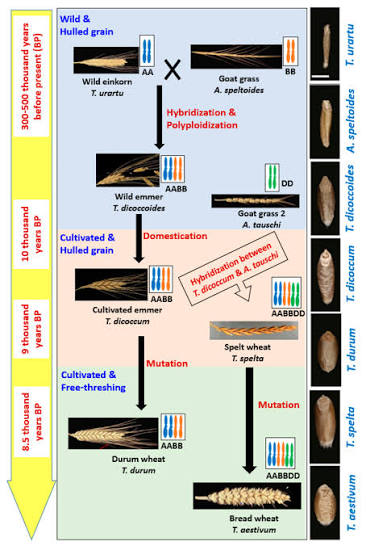
Current_Progress_in_Understanding_
and_Recovering_the_Wheat_Genes_Lost_in_
Evolution_and_Domestication
So WHY Is Everyone Talking About Einkorn?
Now we can get to the part that probably made you click on this post in the first place.
Why does everyone seem to be putting einkorn in everything?
Einkorn has developed a reputation as a more digestible, more nutrient-dense, almost magical version of wheat. You will find claims online that it is easier to digest, that it has less gluten, that it does not cause the same problems as modern wheat, or even that it is somehow the wheat humans were “meant” to eat.
First, the important part: einkorn is wheat, and einkorn contains gluten. It is not gluten-free, and it is not considered safe for people with celiac disease. If you have celiac disease, einkorn is (unfortunately) not a loophole around gluten. However, if you are Non-celiac gluten intolerant, you VERY WELL MAY be able to eat einkorn just fine!
Einkorn has a DIFFERENT protein composition from modern bread wheat, and its gluten behaves differently when you bake with it. If you have ever tried making a loaf of bread with einkorn after becoming accustomed to hard white wheat, you may have discovered this for yourself. Einkorn dough can be much more delicate and sticky, and it does not develop the same strong, elastic gluten network that you may be used to seeing in conventional bread dough.
So basically, einkorn does not always cooperate with your expectations. You can knead it, stretch it, fold it, stare at it suspiciously, and eventually realize that it has absolutely no intention of behaving like standard hard white wheat.
But… then how do you bake with it? I’m getting there. Yes, it’s hard to bake yeast breads with. So first I want to talk about WHY you SHOULD bake with einkorn.
Einkorn’s Nutrition
Einkorn contains a number of vitamins, minerals, carotenoids, antioxidants, and other compounds. One of the easiest things to notice is its beautiful golden color. Einkorn flour is often noticeably more yellow than typical wheat flour, largely because it contains higher levels of carotenoid pigments, including lutein.
One study that grew several einkorn varieties and a modern bread-wheat control under different conditions found that the einkorns consistently had substantially higher lutein and tocotrienol concentrations. And lutein is not just there to make your sourdough look pretty, it’s a carotenoid that accumulates in the human retina and is particularly well known for its role in eye health.
Einkorn also provides a variety of antioxidant compounds, including tocopherols and tocotrienols, polyphenols, alkylresorcinols, and phytosterols. It was found to have particularly high concentrations of several of these compounds compared with other wheats. And remember, antioxidants are our disease-fighting compounds so we really love foods high in them.
Research on ancient wheats as a group has found promising effects on markers related to blood glucose, blood lipids, oxidative stress, and inflammation, particularly in experimental and some human studies. There is ongoing research into Einkorn’s cardiometabolic benefits.
There is even a small human study specifically involving einkorn bread that found differences in the post-meal response of glucose-dependent insulinotropic polypeptide in einkorn bread vs. modern wheats. So there are potential benefits for other areas of metabolic health.
THE BIG ONE, the reason that most people are switching to einkorn is its digestibility! There are a few studies but thousands more anecdotal reports from people with “gluten intolerances” (NOT CELIAC), that they were able to tolerate and enjoy einkorn flour just fine. It is theorized this is because of einkorn’s simpler chromosomal structure, but these reasons haven’t exactly been hammered out yet. We just know the benefit appears to be there for droves of people!
The benefits are even bigger when you mill the whole einkorn berry yourself, because you are not separating the bran and germ away from the flour and then adding a few nutrients back in later. You are grinding the entire grain. The bran, germ, and endosperm all become part of your flour, which means you are getting the whole grain exactly as it came out of the field, (minus the outermost inedible layers called chaff).
HOW DO I BAKE WITH IT??
So einkorn has a different chromosome structure from modern bread wheat, a different protein composition, different baking characteristics, and a distinctive nutritional profile. It tastes different, looks different, and behaves differently in the kitchen.
If you want to use it to make yeast loaves, it WILL NOT rise like store bought flour and it WILL NOT rise like like freshly milled hard white or hard red wheats. Einkorn does not have the genetic structure that allows it to form gluten strands as strong as modern wheats. Even though on paper einkorn has a high gluten content, it actually behaves more like a “soft white wheat” than a hard wheat.
Even though einkorn actually has higher protein and more gluten-forming proteins than modern wheat, it has a weaker gluten network. More gluten DOES NOT always equal stronger gluten strands.
When you mix and knead modern bread-wheat dough, you’re encouraging those gluten proteins to form and strengthen their network. As that network develops, the dough becomes elastic and extensible. You can stretch it, shape it, and build enough structure to hold the gas produced during fermentation. But einkorn doesn’t develop that same kind of strong gluten network.
Imagine it like this: You have 100 people trying to hold up a tent. You could have 100 people standing around the tent, but if they are not all holding their corner of the tent (maybe they’re weak or confused at what to do), you’ve got a pretty lousy tent structure. Modern bread wheat is better at getting those people to actually link arms and hold up their corner. Einkorn has plenty of people, they just aren’t nearly as good at organizing themselves.
So this is why einkorn does not rise like modern wheat varieties. This is what ancient bread used to look like:
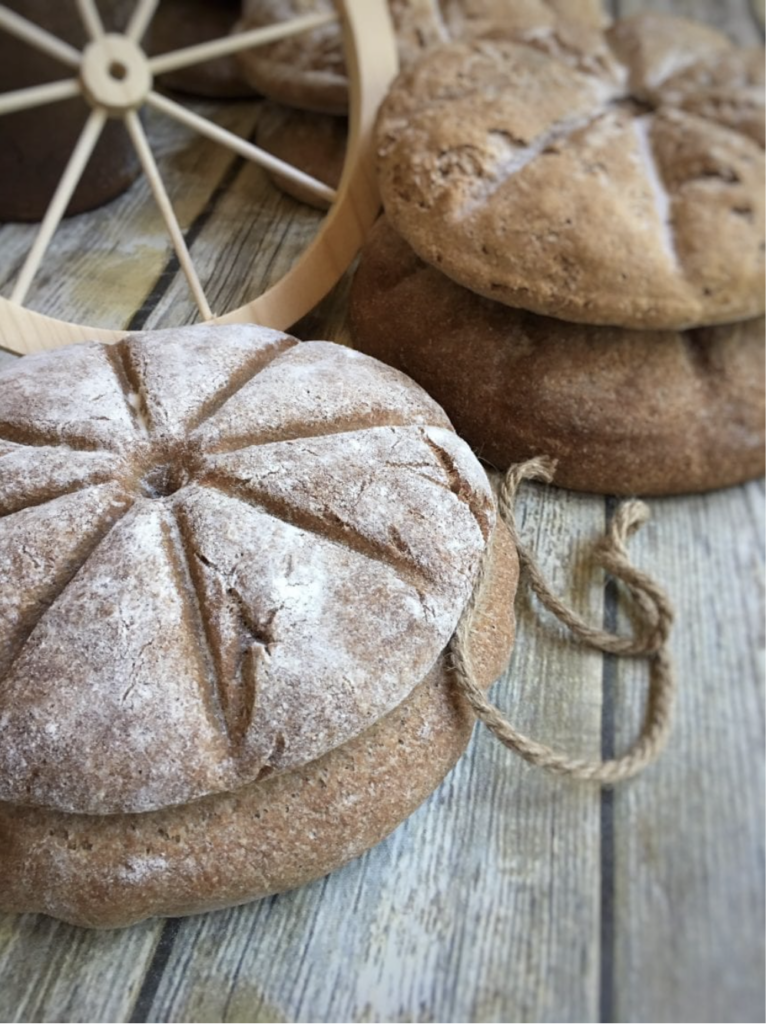
Ancient bread was not expected to puff up like the light, white, and extremely fluffy bread we are used to today. It was expected to behave like real food, not a jet-puffed carby endosperm dessert. (Don’t get me wrong, I love me some white bread, but we cannot pretend that it belongs as part of a nutritious meal – it’s a lovely treat, snack, or dessert).
How to Bake a Sandwhich Loaf with Einkorn:
You have a few options to try. These will make your loaf more “loaf-y”, but still expect it to be a bit denser than you are used to.
- You can cut it with hard white wheat (50/50).
- You can cut it with store bought flour (whatever percentage you want)
- You can get sifted einkorn from somewhere like Einkorn.com (this is not freshly milled and will not contain the bran or germ, but it will be fluffier flour)
My Preferred Way of Using Einkorn: In everything else!
We eat way more than yeast breads! You can use einkorn quite easily in:
- Crackers
- Muffins
- Cookies
- Cakes
- Brownies
- Flat bread
- Dumplings
- Pasta
- Pie crusts
- Dutch Babies
- Homemade cinnamon toast crunch cereal
- Anything that doesn’t call for yeast!
So if you are wanting to incorporate einkorn into your diet for its amazing health benefits, you can trade it out 1-to-1 by weight for any of your favorite non-yeast recipes!
Happy baking and remember, all glory to the One who created it all!
❤️ Rachel
Sources:
Do ancient wheats contain less gluten than modern bread wheat, in favour of better health?
https://pmc.ncbi.nlm.nih.gov/articles/PMC9322029
Ancient Wheats—A Nutritional and Sensory Analysis Review
https://pmc.ncbi.nlm.nih.gov/articles/PMC10297139
Einkorn genomics sheds light on history of the oldest domesticated wheat
https://pmc.ncbi.nlm.nih.gov/articles/PMC10447253
Genes and Mutations Underlying Domestication Transitions in Grasses