Breaking Ground: How Daikon Radishes Taught Me to Heal Clay Soil
When my husband and I lived in Japan with the military, I quickly learned that gardening looks a little different everywhere you go. In Japan, even the smallest plots of land are treated like treasure. Tiny raised beds brim with greens, herbs, and – everywhere you look – daikon radishes.
At first, I thought they were just a staple vegetable. Long, white, and unassuming. They were cheap and used a lot in fermenting. But one day, a local Japanese woman I’d often see tending her garden stopped to chat with me. In the sweetest way, she gave me a bit of advice:
“Be careful not to plant daikon too close to your patio,” she said with a smile. “They’ll grow through the pavers and crack them.”
I laughed, but she wasn’t joking. Daikon radishes are powerful growers. Their roots are strong enough to push through compacted earth – and apparently, even through concrete if given the chance!
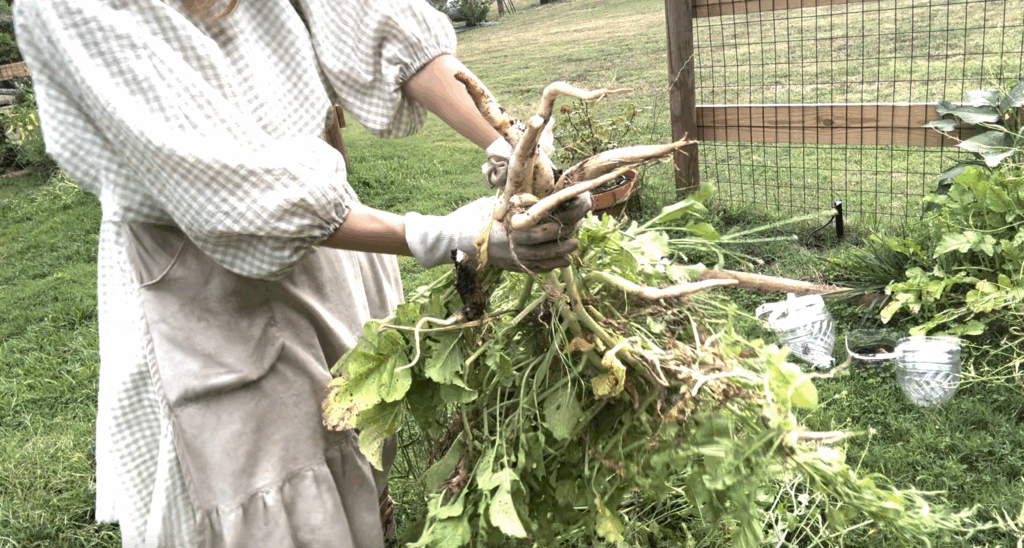
I planted these daikon radish seeds in the summer because I wanted to experiment. They did not grow nearly as big as they would in cold weather. So my advice: wait until Fall to plant.
Nature’s Little Tiller
When we moved back to the States, we bought a home, and I started working in my own garden here at Winding Row Cottage, I finally understood just how special that advice was.
Clay soil, for all its nutrient potential, is a my (and many other gardener’s) headache. It’s heavy, sticky, doesn’t drain, and suffocates roots. But daikon radishes, especially the long-rooted tillage types, are a secret weapon. And I easily found daikon radish seeds at my local feed and seed store here in NC, because they are actually known around the world as a fantastic (and cheap!) cover crop.
The USDA Natural Resources Conservation Service notes that tillage radishes can improve infiltration and root growth for future crops.
When planted in late summer or early fall, they send their roots deep into the ground, breaking up dense clay and creating channels for air and water. By the time winter comes and those radishes die back, their roots decompose, leaving behind natural pathways that loosen the soil.
It’s nature’s version of aerating your garden without the machinery.
The Science
Daikon radishes are sometimes called bio-tillers, and for good reason. Their thick taproots can push several feet into the soil, loosening dense layers of clay and compacted subsoil as they grow. When those roots die back, they leave behind natural tunnels that improve air flow and water infiltration, essentially aerating the soil without a machine. As they decompose, the organic matter from the roots feeds soil microbes, increases carbon content, and helps bind soil particles into crumbly aggregates that plant roots love.
They also act as nutrient scavengers. While growing, daikons pull nitrogen and other minerals from deep layers that would otherwise leach away. When the plants break down, those nutrients are released near the surface, right where your next crop can use them. That combination of breaking up hardpan, improving drainage, and cycling nutrients makes daikon radishes one of the simplest, most natural ways to heal heavy or neglected garden soil. Just be mindful not to plant them too close to your patio, or they might try to till that too!
How to Plant Daikon Radishes for Soil Health
Avoid hardscaping edges!
And yes, take that sweet Japanese gardener’s advice, don’t plant them near pavers, patios, or pathways unless you want to test their strength.
Choose the right variety.
Look for “tillage radishes” or “cover crop daikon radishes.” These are bred for soil improvement more than eating. Though, you still CAN eat them if you wanted to pull a few!
Direct sow in late summer or early fall.
Plant seeds about ½ inch deep, spacing them 4-6 inches apart in rows 12 inches apart… or just aimlessly and chaotically throw them into the soil like I did. You do you.
Let them grow and die in place.
Don’t harvest-just let nature do the work. The tops will die back after frost, and the roots will begin decomposing underground.
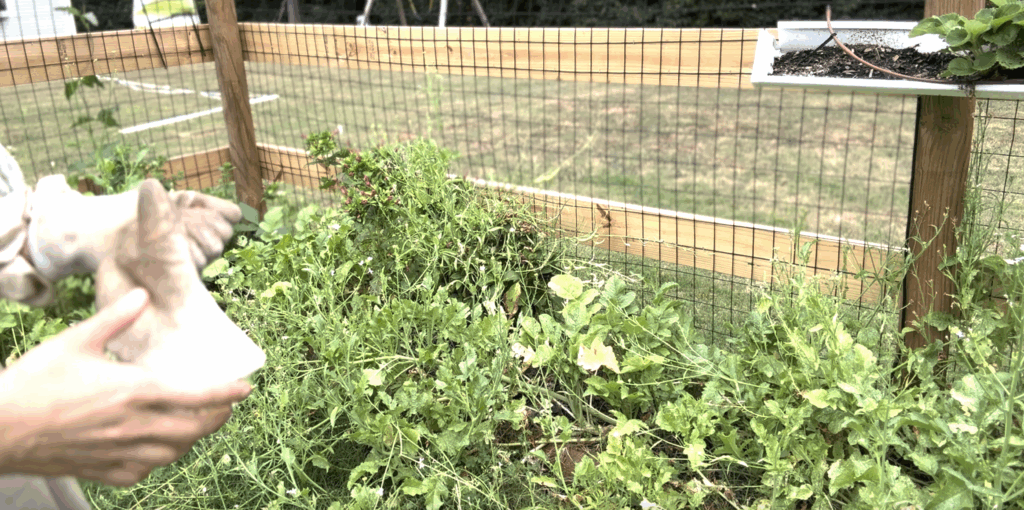
The tops of all the Daikons that I overplanted. They flowered and the butterflies loved them. I cut the tops off of most of these and fed them to the chickens.
How Daikon Radishes Taught Me to Heal Clay Soil
It still amazes me that something as humble as a radish could break concrete. There’s a quiet wisdom in that… soft power doing what brute force often can’t.
Now, every time I sow daikon seeds, I think of that Japanese woman’s gentle warning. Her words remind me that tending the soil – like tending life – often means loosening what’s compacted, letting roots breathe, and trusting small, steady growth to do the work over time.
I’ll give y’all an update in the coming months as I planted about 100 daikon seeds in the garden for a Fall cover crop!